
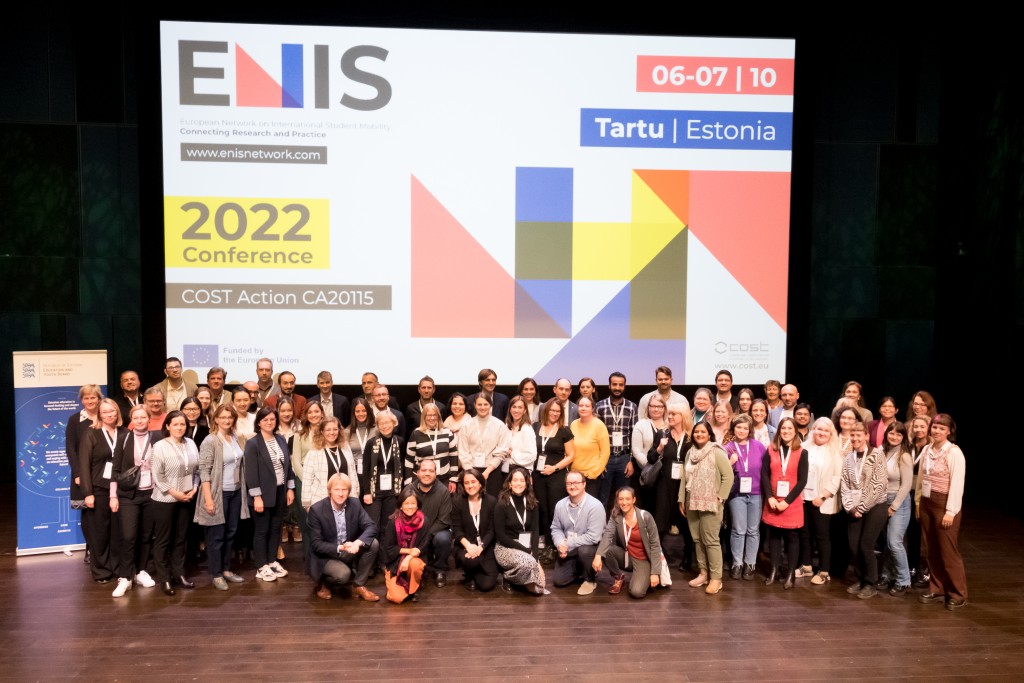
The highlights of the conference were presentations of thematic reviews on the impact of the Covid-19 pandemic on social inequalities related to International Student Mobility, on the social and cultural integration of international students and on employability outcomes. The keynote speech was given by Giorgio Marinoni from the International Association of Universities.
"This wonderfully organized conference by the Estonian Education and Youth Board was a major step in the effort our network undertakes to connect research and practice on international student mobility. Such events help to start a conversation between both groups - researchers and practitioners, which often work on isolated islands," commented Christof van Mol, COST ENIS Action Chair.
"It was an honour to bring COST ENIS conference to Estonia. Our national higher education internationalisation strategies have got the recognition from World Bank and additionally the British research center I-Graduate has highlighted Estonia as the best performing host country governmental service impacting students’ choice of institution," commented Eero Loonurm, the head of the national higher education promotion programme "Study in Estonia".
"Estonia was in this way the right meeting place for researchers and practitioners," Loonurm added.
The European Cooperation in Science and Technology (COST) is a funding organisation for the creation of research networks, called COST Actions. These networks offer an open space for collaboration among scientists across Europe (and beyond) and thereby give impetus to research advancements and innovation.
COST is bottom up, this means that researchers can create a network – based on their own research interests and ideas – by submitting a proposal to the COST Open Call. The proposal can be in any science field. COST Actions are highly interdisciplinary and open. It is possible to join ongoing Actions, which therefore keep expanding over the funding period of four years. They are multi-stakeholder, often involving the private sector, policymakers as well as civil society.Since 1971, COST receives EU funding under the various research and innovation framework programmes, such as Horizon 2020.
Additional information:
Programme COST ENIS
COST - European Network on International Student Mobility: Connecting Research and Practice
HARNO news. October 2021
Estonian Education and Youth Board will be represented in the COST Association, the oldest intergovernmental framework for European co-operation in the field of Science and Technology
HARNO photo album
Photo album: COST ENIS Tartu 2022 Annual Conference
I-Graduate Case studies
Estonia’s shining example of an evidence-informed internationalisation strategy
Eero Loonurm
Head of Study in Estonia
Estonian Education and Youth Authority
e-mail: [email protected]

